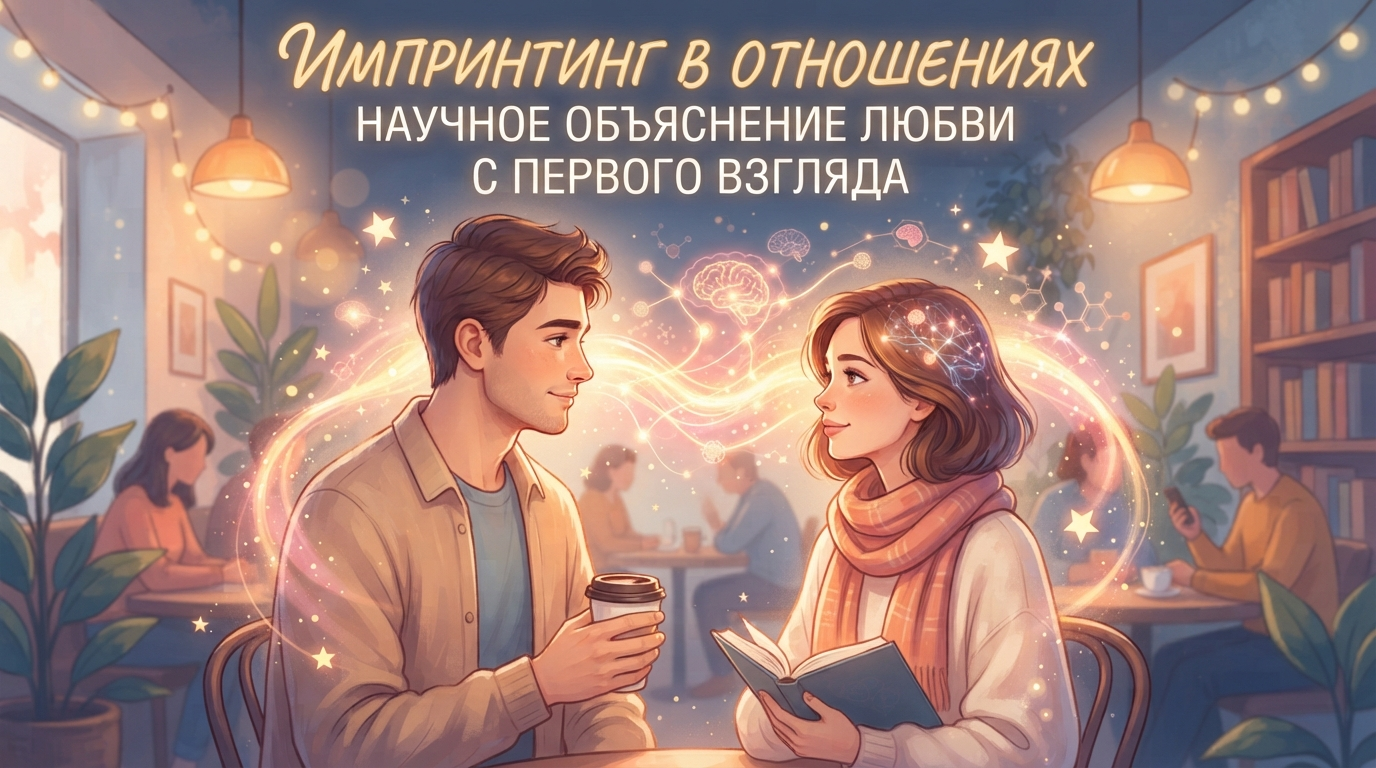
Импринтинг в отношениях: научное объяснение любви с первого взгляда
Why are we drawn to certain people and indifferent to others? Poets call it chemistry, mystics call it fate — but scientists call it imprinting, and they have decades of data proving that love at first sight is not just a romantic myth.
The Science of Imprinting
Konrad Lorenz won a Nobel Prize for discovering imprinting in animals — the process where newborns form an instant, permanent attachment to the first moving object they see. Decades later, researchers proved similar mechanisms operate in human relationships.
A 2023 study in Evolution and Human Behavior found that people consistently choose partners who resemble their first serious crush — even when unable to articulate the similarity. Neural network analysis confirmed the visual patterns.
Subconscious Decision Making
Scientists at Humboldt University used eye-tracking to prove that attractiveness judgments form in under 300 milliseconds — before conscious awareness. The brain evaluates a face for compatibility with your internal template before you even know you are looking.
Conscious analysis begins 3-5 seconds later, but by then the first impression is already formed. This explains why initial attraction is so hard to override with rational analysis.
Similarity vs Complementarity
The similarity-attraction effect is one of the most robust findings in social psychology. A meta-analysis covering 50 years and 30,000 participants confirmed: shared values predict compatibility (correlation 0.62), while personality differences barely matter (0.12).
The popular myth that ‘opposites attract’ is not supported by data. We seek partners who reflect our core values — not exact copies, but people who share what fundamentally matters to us.
Key Data
- Shared values: correlation 0.62 with relationship success
- Visual attraction: correlation 0.35 — significant
- Social status: correlation 0.28
- Personality difference: correlation 0.12 — negligible
We do not fall in love — we recognize. The brain scans a new person for alignment with a template built from years of experience. When it matches, we feel the spark.
Summary
U
n
d
e
r
s
t
a
n
d
i
n
g
t
h
e
p
s
y
c
h
o
l
o
g
y
o
f
a
t
t
r
a
c
t
i
o
n
d
o
e
s
n
o
t
m
a
k
e
l
o
v
e
l
e
s
s
m
a
g
i
c
a
l
.
I
t
m
a
k
e
s
t
h
e
s
e
a
r
c
h
m
o
r
e
e
f
f
i
c
i
e
n
t
.
W
h
e
n
y
o
u
k
n
o
w
t
h
a
t
s
h
a
r
e
d
v
a
l
u
e
s
m
a
t
t
e
r
m
o
r
e
t
h
a
n
s
u
r
f
a
c
e
c
h
a
r
a
c
t
e
r
i
s
t
i
c
s
,
y
o
u
c
a
n
f
o
c
u
s
y
o
u
r
e
n
e
r
g
y
w
h
e
r
e
i
t
c
o
u
n
t
s
.
импринтинг, любовь с первого взгляда наука, психология влюбленности