I spoke with psychotherapist Anna Kovalyova. She has worked with couples for 25 years. I asked her: what is the most common request from clients? She smiled and replied: bring me that special person, doctor. And quickly. We both laughed. Then she said seriously: the problem is not that people can’t find a suitable partner. The problem is that they look for them in the wrong place. Not in other people’s profiles — in their own reflection.
Imprinting: What It Really Is
Konrad Lorenz, an Austrian zoologist, won the Nobel Prize in 1973 for discovering imprinting. The experiment was simple and brilliant: newborn goslings considered the first moving object they saw after hatching to be their mother. If that object happened to be Lorenz himself in rubber boots, the goslings followed him everywhere.
With human romance, it’s more complex, but the principle is the same. In childhood and adolescence, we form a subconscious template. Facial features, voice timbre, manner of laughing, body type. This template is built from first crushes, images of significant adults, and cultural context. And when we meet someone who matches this template by at least 70 percent, our brain shouts: this is it!
A 2023 study published in the journal Evolution and Human Behavior (one of the most authoritative journals in evolutionary psychology) confirmed this hypothesis. Researchers took photos of participants’ first strong crushes and compared them with photos of their current partners. The correlation was statistically significant: people subconsciously choose partners who resemble their first love. Moreover, participants couldn’t explain what exactly attracted them to their partner — neural network analysis of the photos showed objective similarity at a level that the eye perceives but consciousness does not register.
What Happens in the Brain at the Moment of Meeting
Professor Mikhail Lebedev, a neuroscientist at the Institute of Higher Nervous Activity of the Russian Academy of Sciences, explained the mechanism to me in a personal conversation. When a person sees a face that matches their subconscious template, functional MRI shows activation of the same brain areas as when looking at a photo of a loved one. Literally the same ones. The ventral tegmental area, nucleus accumbens, orbitofrontal cortex — dopamine centers responsible for reward and attachment.
The difference between the states of “I’ve fallen in love” and “I recognize a kindred spirit” at the neural level is zero, says Lebedev. The brain draws no distinction. For it, new attraction and old attachment are the same process, triggered by the same neural circuits. This explains why we sometimes feel we’ve known someone all our lives, even though we met them five minutes ago. In a sense, we have — our brain already knows them.
Opposites Don’t Attract: What the Data Says
Popular culture harbors a beautiful idea: opposites attract. Introvert and extrovert, rebel and conservative, artist and accountant — they meet and become the perfect couple. The problem is that reality doesn’t support this hypothesis.
The largest meta-analysis in the history of relationship psychology was published in 2024 in the Journal of Personality and Social Psychology. Researchers combined 313 individual studies over 50 years with a total of 78,000 participants. The conclusion is unequivocal: the strongest predictor of compatibility is similarity of values, with a correlation of 0.62. For comparison: the correlation between smoking and lung cancer is about 0.40. In other words, shared values predict relationship success better than smoking predicts cancer.
Physical attractiveness is the second most significant factor, with a correlation of 0.35. Social status — 0.28. But personality traits like introversion-extroversion yield a correlation of only 0.12. This means you can be a total extrovert and your partner an introvert, and it will have almost no effect on your compatibility if your life values align.
300 Milliseconds: Why First Impressions Are Deceptive
Our brain makes a decision about a person’s attractiveness in 300 milliseconds. That’s less than a blink. Imprinting, upbringing, cultural context, and tens of thousands of faces seen before deliver a verdict in that time. The problem is that we trust this verdict 100 percent. Saw — liked — thought: fate. Or the opposite: didn’t notice — swiped past — walked by someone with whom we could have been happy.
Psychotherapist Esther Perel, whose TED talks have garnered over 30 million views, says on this matter: love is not about finding someone who suits you. It’s about building a relationship with the person you’ve chosen. The difficulty is that we confuse “I’m attracted” with “I feel good with them.” The former is imprinting. The latter is compatibility. Modern matching technologies help separate one from the other.
Why We Choose the Wrong People and How to Fix It
Psychotherapist Dmitry Petrov, who has worked with couples for 18 years, noticed a pattern: the most successful relationships begin with those who approach dating not from the position of “choose me,” but from the position of “I choose you.” The difference is one letter, says Petrov, but a chasm in reality. In the first case, you’re seeking approval. In the second, you’re seeking a partner. These are two fundamentally different vectors.
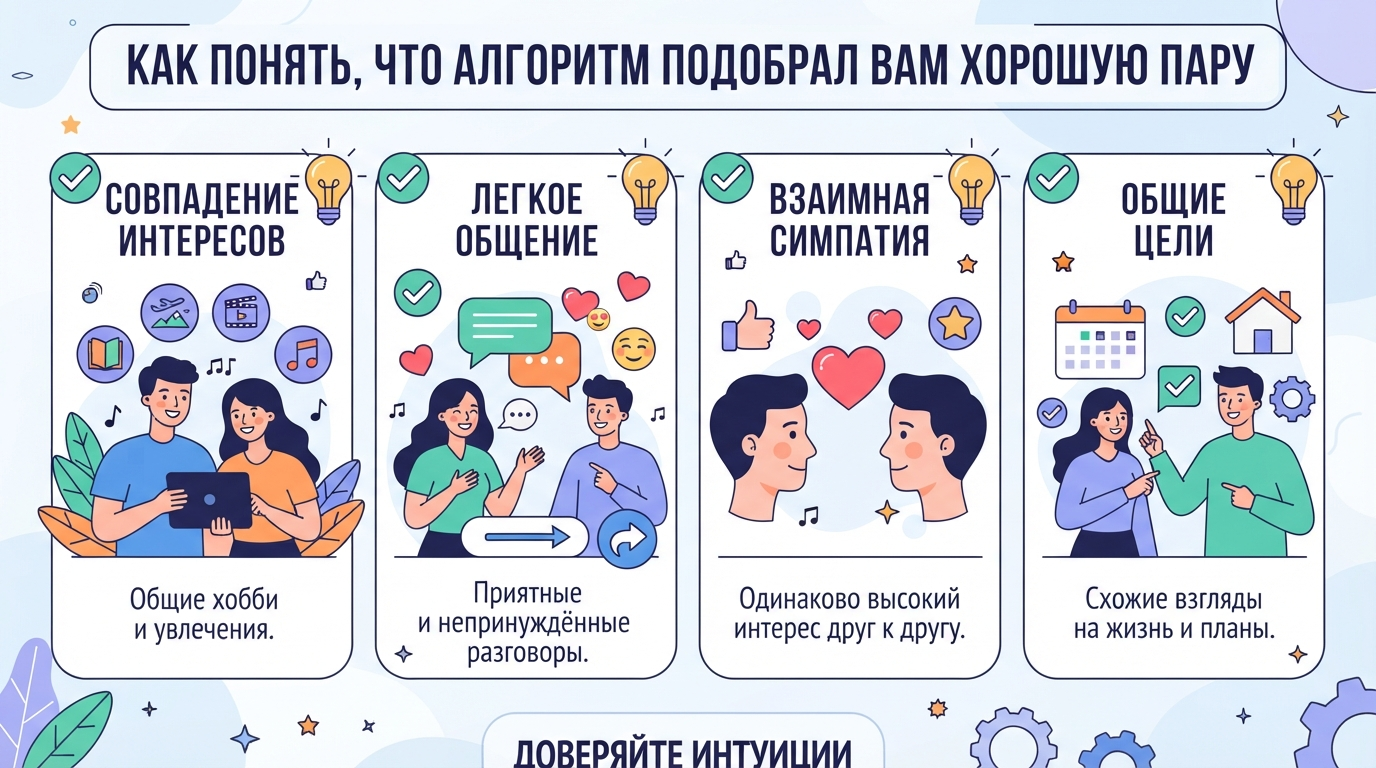
Matching technologies don’t solve this problem, but they offer an important advantage: they show that beyond your 300-millisecond filter, there are many people with whom you could have deep compatibility. You just never notice them in the endless swipe feed. But an algorithm will.
Anna Kovalyova, with whom I started this story, summed it up at the end of our conversation: people come to me with the question — where to find the ideal partner? And I answer: first, figure out why you think the current candidates are not ideal. Often the problem isn’t them. The problem is your internal filter, which is set to search for something that doesn’t exist. Turn it off. Look wider. Give a chance to those you usually don’t notice. And then, perhaps, you won’t have to search — you’ll simply meet.
Read also: first impressions, psychology of dating, 7 seconds